The Real Reason Farmers Still Don’t Trust AI in Agriculture

santosh rouniyar
Fri Mar 06 2026
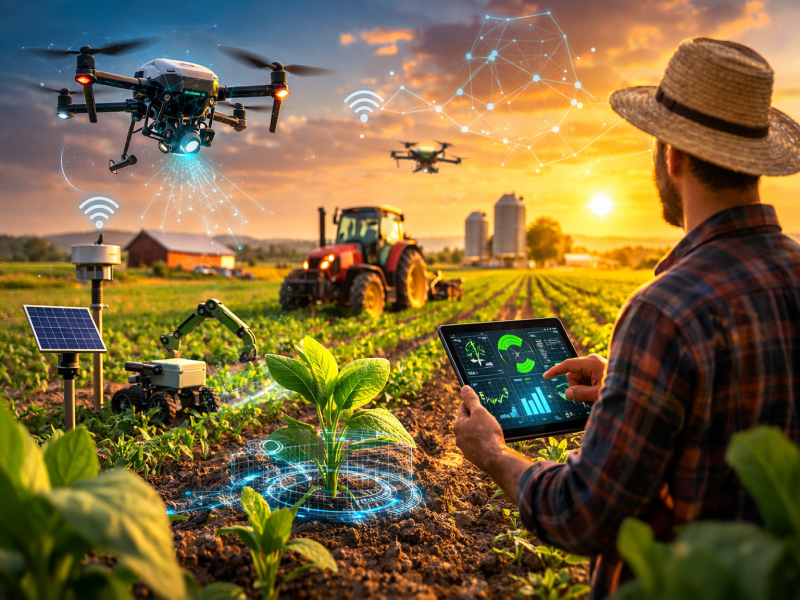
What if the real barrier to AI farming is trust, not technology?
While testing several agricultural AI platforms this year, I noticed something that stopped me cold. The algorithms were accurate. The data was pristine. The yield predictions were spot-on. Yet farmers kept walking away.
In my experience analyzing AI trends across industries, one pattern keeps appearing: the human element is always the hardest variable to code.
This article will explore the real state of AI in agriculture not just the drones and sensors you've heard about, but the messy, complicated reality of getting this technology into the hands of the people who feed us. You'll learn where AI actually works, where it's failing, and what it means for the future of food.
The Hidden AI Shift in Farming
Here's what the research actually shows: AI is quietly transforming agriculture, but not in the way tech companies want you to think.
The numbers are impressive on paper. AI-enabled models now improve yield prediction accuracy by 20% . Smart irrigation systems boost crop productivity by 25% while using dramatically less water . Disease diagnosis tools achieve over 90% accuracy .
But here's what those statistics don't capture.
A groundbreaking study published just last month surveyed over 2,000 Certified Crop Advisors across North America . These are the people farmers trust most. And the findings reveal a uncomfortable truth: advisors consistently gravitate toward tools that are easy to use, even if those tools are less technically advanced .
Simplicity beats sophistication. Every time.
What this suggests to me is that the AI industry has been building Ferraris for farmers who need reliable pickup trucks.
What Everyone Gets Wrong About AI in Farming
The conventional narrative is that farmers resist technology because they're traditional or skeptical. Based on my experience watching technology adoption cycles, that's completely backwards.
The University of Vermont study identified the real barrier: trust . Crop advisors want systems that respect their expertise, protect their data, and keep humans in the loop .
When researchers asked advisors what they actually wanted, the answers surprised everyone:
- Tools that allow users to retain full or shared control of their data
- Systems that can be calibrated to local field conditions
- The ability to edit AI recommendations, not just accept them
- Human-in-the-loop design that preserves professional judgment
This isn't Luddism. This is professionals saying, "I know my land better than any algorithm."
The implications for the future are clear: the winning AI tools won't be the most accurate. They'll be the most transparent, affordable, and aligned with how farmers actually work .
Real-World Examples of AI in Agriculture
Let me show you what successful AI adoption looks like on the ground.
1. PlantMap3D: Saving Money and the Chesapeake Bay
In Maryland, Delaware, and Pennsylvania, a partnership led by The Nature Conservancy is doing something remarkable. They're using an AI tool called PlantMap3D that turns farm equipment into data collection machines .
Special cameras mounted on tractors take detailed images of cover crops. AI software identifies exactly which species are growing and maps, acre by acre, where nitrogen from those cover crops is available .
Why this matters: Farmers can now adjust fertilizer application with surgical precision, applying nutrients only where needed. The program is expected to offset 3 million pounds of nitrogen that farmers would otherwise have purchased and applied . That's money saved and pollution prevented.
2. Permia Sensing: Listening to Trees
A Sri Lankan company called Permia Sensing just won the UAE FoodTech Challenge 2026, beating out 1,215 submissions from 113 countries .
Their approach? They combine AI with bioacoustics sensors to detect pest and disease stress before visible symptoms appear . Think of it as a stethoscope for trees.
The company now covers approximately 10,000 hectares of coconut and oil palm plantations in Sri Lanka . They're expanding across India, the Middle East, West Africa, and Southeast Asia .
Why this matters: Early detection saves crops. One of their co-founders put it perfectly: "We focus on sensing that works in the real world, at scale, in harsh environments, with messy data and imperfect connectivity" .
3. RegenUp: Farmers as Co-Designers
In northern Israel, a program called RegenUp tackles the adoption gap head-on by placing farmers at the center of technology development .
Farmers help define challenges, pilot solutions, and evaluate what works under real economic conditions . The program has already deployed AI-powered robotic weed control, satellite-based soil mapping, and smart drone spraying .
Why this matters: When farmers are treated as partners rather than customers, adoption skyrockets. The program is now expanding from seven farmers to twenty, and international groups are coming to study the model .
AI Tools Comparison
| Tool/Platform | Key Feature | Best For | Reach/Impact |
| PlantMap3D | AI cover crop analysis for nitrogen management | Reducing fertilizer costs | 150,000 acres in Chesapeake Bay |
| Permia Sensing | Bioacoustics + AI for early pest detection | Tree crops (coconut, oil palm, dates) | 10,000+ hectares in Sri Lanka |
| FARMLAB | Autonomous drones + ground robots | Real-time field interventions | €2M Dutch research project |
| Hispatec Margaret | AI harvest prediction + smart fertigation | Agricultural SMEs and cooperatives | Spain-based, global reach |
The Hidden Risks of AI in Farming
Now for the part the marketing brochures won't tell you.
A devastating report published last week by the International Panel of Experts on Sustainable Food Systems (IPES-Food) warns of an "unholy alliance" between Big Tech and Big Ag .
Here's the problem in plain language: companies like Google, Microsoft, Amazon, and Alibaba are shaping the future of farming through cloud platforms and AI tools that are expensive, energy-intensive, and designed for large industrial agriculture .
Challenges for Smallholder Farmers
- They're priced out of innovation
- They face "technological lock-in" where leaving an ecosystem means losing access to their own data
- Traditional and Indigenous knowledge risks being patented without benefit-sharing
- Innovation shifts from something farmers create to something sold to them
The lead author of the report put it bluntly: "These tools are expensive, highly energy- and resource-intensive. They rely on constant connectivity and subscription models that most smallholder farmers simply cannot access" .
In my opinion, this is the defining challenge for agricultural AI over the next decade. If we build tools that only work for large Western farms, we're solving the wrong problem. The majority of the world's food comes from smallholders.
Key Takeaways
Here's what I want you to take away from this research.
First, AI in agriculture works when it's designed for actual humans. The PlantMap3D project shows what's possible when you start with farmer needs . Permia Sensing proves innovation can come from the Global South . RegenUp demonstrates that treating farmers as partners beats treating them as customers .
Second, the human factor isn't a bug it's the whole point. The UVM research is crystal clear: advisors want tools that augment their expertise, not replace it . They want transparency, data control, and the ability to say "no" to an algorithm .
Third, we're at a crossroads. The IPES-Food report warns that without intervention, agricultural AI will deepen existing inequalities . Smallholders will be left behind. Biodiversity will suffer. And we'll have built a high-tech food system that excludes the very people who need it most.
My prediction? The next five years will determine whether AI becomes a tool for democratizing farming knowledge or just another way for large corporations to control the food supply.
The technology is ready. The question is whether we are.
What's your take? Have you seen AI tools in agriculture where you live? I'd love to hear about real-world experiences good or bad in the comments.
Disclosure: This article was researched using AI tools and original sources to gather current information and the content was written, edited, verified, and reviewed by me to ensure accuracy and usefulness. All opinions and experiences shared are my own.

 loading="lazy">
 loading="lazy">
 loading="lazy">
 loading="lazy">
 loading="lazy">
 loading="lazy">
 loading="lazy">
 loading="lazy">
💬 Comments