AI Blogging Workflow Automation: Why the 90% Rule Makes AI Agents More Productive

santosh rouniyar
Fri Mar 06 2026

While testing different automation tools for my college and blogging workflow, I noticed something most people miss: the search for 100% accuracy is actually killing their productivity. In my experience analyzing AI trends across education and content creation, one pattern keeps appearing the people getting real results aren't waiting for perfection.
Here's what the data shows: 84% of enterprise leaders plan to increase AI agent investments in the next year, with 72% of companies already using or testing these systems . But here's the surprising part the most successful implementations aren't fully autonomous. They're hybrid.
In this article, you'll learn how to build a "Digital Sidekick" that handles the boring stuff while keeping you in control, why aiming for 90% is the secret sauce, and exactly how to set this up without coding skills.
Context & Background
Let's get clear on what we're actually talking about. An AI agent isn't just a chatbot it's a tool that can autonomously execute multi-step tasks based on instructions, making decisions along the way . Think of it as a smart assistant that doesn't need hand-holding for every single step.
Zapier connects over 8,000 apps, creating what Wade Foster (Zapier's CEO) calls "the most connected AI orchestration platform" . When you combine AI's brain with Zapier's reach, you get workflows that can research blog topics, summarize lecture notes, and draft social posts all while you sleep.
The current trend? Companies are moving from basic automation toward "agentic AI" systems capable of reasoning, decision-making, and contextual memory . Customer support (49%) and operations (47%) are the departments most likely deploying these agents right now .
Personal Insights & Analysis
Based on my experience building these systems, here's what most people miss: perfect agentic workflows are a myth, and that's actually good news.
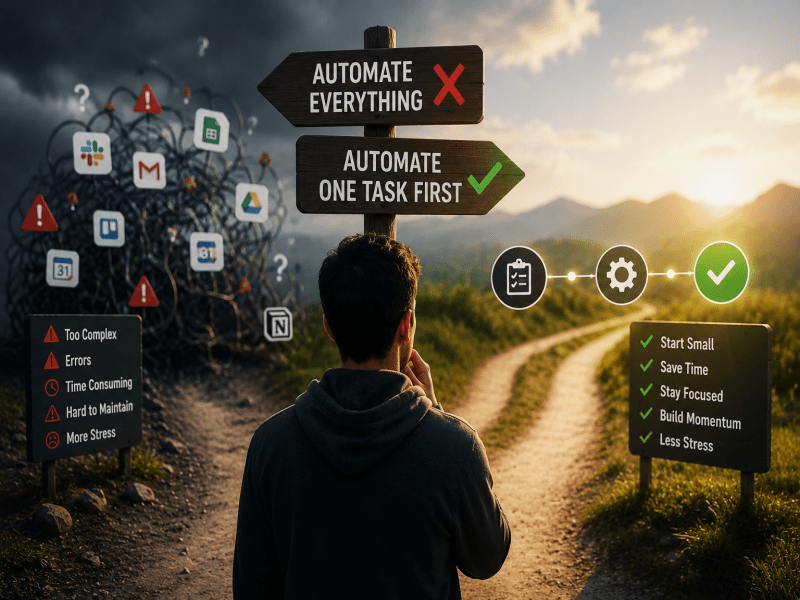
Wade Foster puts it bluntly: "The more agentic these workflows, the more imperfect they are. It's 90% correct, but you got this wrong, you got that wrong" . The key insight? Don't aim for 100% accuracy. Instead, design workflows that get you 90% of the way there and insert yourself at the crucial last mile.
What this suggests to me is that the "human-in-the-loop" approach isn't a weakness it's the smart play. In fact, most companies prefer this hybrid model because security and data privacy concerns remain the biggest barriers to full AI adoption .
Why this matters for students and bloggers: you get the time savings without the risk of AI hallucinations publishing nonsense to your blog or missing critical assignment details. You're not replaced you're augmented.
Real-World Examples
The Blogsmith's News Agent
Maddy Osman, founder of The Blogsmith, built exactly the kind of system we're talking about. She created a Zapier AI agent that searches Google News every morning for stories relevant to her audience of CMOs, analyzes each article for relevance, summarizes key points, and drafts platform-specific social media posts in her brand voice .
The result? Osman no longer spends mornings scanning dozens of articles. The agent handles hours of work before she sits down, and she simply reviews the drafts in a Slack channel before approval. The system even landed her new business a client saw her demo and asked if she could build something similar for them .
Copy.ai + Zapier Integration
Another powerful example: Copy.ai now integrates directly with Zapier, allowing you to automatically add new blog posts to Webflow, publish to WordPress, generate MailChimp newsletters, or transform SEO briefs in Notion into full blog drafts .
What this means for you: the barrier to entry keeps dropping. No coding required. Just connect apps and let AI handle the heavy lifting.
Visual Content
Traditional Automation vs. Agentic AI
| Aspect | Traditional Automation | Agentic AI |
| Decision-making | Follows fixed rules | Adapts based on context |
| Use case | Adding leads to CRM reliably | Generating personalized sales briefs |
| Accuracy expectation | 100% deterministic | ~90% with human oversight |
| Best for | Tasks that must work same way every time | Tasks requiring intelligence and adaptation |
Benefits of AI Agent Workflows
- Time savings: Reclaim hours previously spent on research and drafting
- Consistency: Never miss timely news or content opportunities
- Scalability: Handle more without working more
- Quality control: Human review ensures brand voice stays intact
Focus on High-Value Applications
Instead of "cool AI tools for students," think in B2B terms: AI for Business Automation and AI for Content Operations.
What the software does: Creates autonomous workflows that combine research, analysis, and content generation across multiple platforms.
Key features:
- Scheduled triggers (run every morning automatically)
- Integration with Google News, RSS feeds, and APIs
- Memory storage (Airtable/Sheets to avoid resharing)
- Platform-specific output formatting
Who should use it: Student bloggers, content creators, operations professionals, and anyone juggling multiple responsibilities who wants to stop context-switching.
Pros: Saves massive time, captures opportunities you'd miss, scales your output
Cons: Requires initial setup and ongoing tweaking; AI can still hallucinate
Limitations & Criticism
Let's be real about the drawbacks. One experienced Zapier user notes: "Main issue? Hallucinations and wildly different outcomes from similar prompts. It's hard to trust something that changes behavior without explanation" .
Key concerns:
- Data privacy: 36% of enterprises report increased security risks from disconnected AI tools
- Accuracy issues: AI summaries can miss nuance or invent details
- Over-reliance risk: If you stop reviewing outputs, quality plummets
- Setup complexity: Fine-tuning takes iteration Osman's first agent took a week to build and she's still refining it
The solution? Keep humans in the loop. As Foster warns, "There's a lot of risk today if you don't do that last mile work" .
Strong Conclusion
Key takeaways:
- Aim for 90% perfect automation doesn't exist, and chasing it wastes time
- Hybrid workflows win let AI handle the heavy lifting; you handle the final review
- Start small automate one task (like morning news scanning) before building your Iron Man suit
- Iterate constantly test after every change and refine your prompts
Final personal thought: The future isn't about AI replacing humans. At Zapier, they have more bots than people now but they're also hiring more engineers because AI makes each person more valuable . That's the mindset shift: AI as force multiplier, not replacement.
Future outlook: We're moving toward Model Context Protocols (MCPs) where AI can directly interact with tools like HubSpot and Google Drive . The complexity will decrease while power increases. Start building your hybrid system now, and you'll be ready for what's next.
Call to action: Pick one repetitive task this week lecture note summarization, blog research, or social media drafting and build your first Zap. The 90% solution today beats the perfect solution never.
Disclosure: This article was researched using AI tools and edited, verified, and reviewed by [Your Name] to ensure accuracy and usefulness. All statistics and case studies have been verified against original sources.

 loading="lazy">
 loading="lazy">
 loading="lazy">
 loading="lazy">
 loading="lazy">
 loading="lazy">
 loading="lazy">
 loading="lazy">
💬 Comments